
 Saturday 16th May 2026
Sarah Bedford, the Senior Reserves officer for the LRWT (Wildlife Trust) led this special walk in memory of Jenny, who was herself once the Senior Reserves officer for Merry’s meadows and other LRWT reserves. So, it was good to see eleven members of both the Rutland Nats and LRWT come together for a walk in Jennys favourite wildflower meadow.
It was a cloudy cool start to the morning as we gathered at the entrance to Cow pasture Close and before we set off, Sarah gave us a potted history of all three meadows – Cow pasture Close, Long Meadow and Donkey Paddock (13 hectares in all) and why they are so important to preserve in our two counties. Only 3% of truly pesticide, fertilizer free wildflower meadows still exist in Britain today and Merry’s meadows is a glowing example of how these grassland meadows should look like at this time of year.
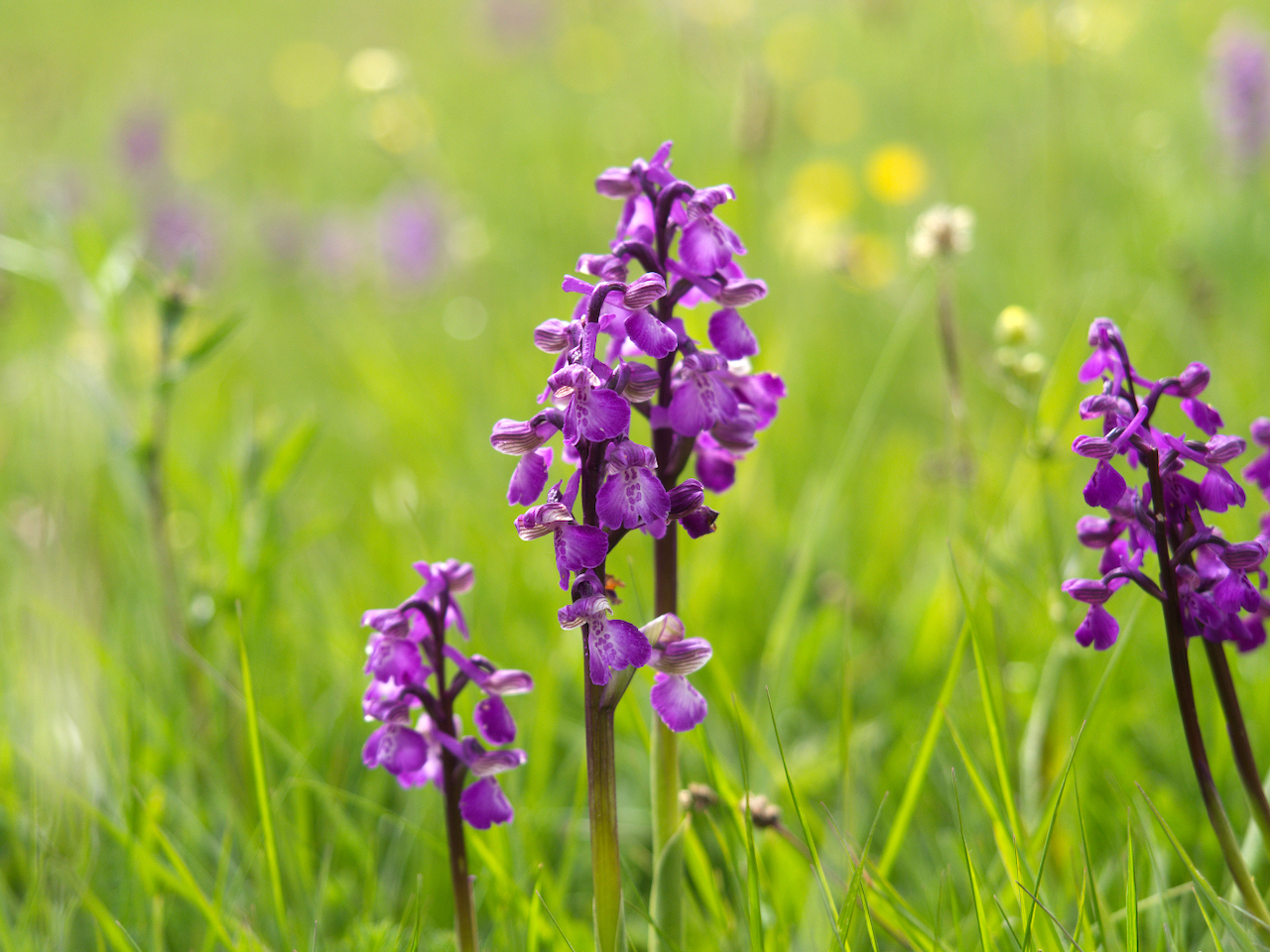
Almost immediately our list of flowering plants grew, dominated by a purple haze of hundreds of Green-winged orchids and the brown husks of cowslip flowers seeding everywhere. Sarah reminded us of the way old traditional hay meadows were managed in the fields of Britain for hundreds of years in the past and how they teemed with all kinds of birds, butterflies and insects, all depending on one another for their future survival, and how the Trust now manage and care for these meadows in the same traditional way. Sarah recounted how Jenny once quoted “we had just finished counting 5000 Green-winged orchids in Cow Pasture Close. . . when we heard a peculiar sound of a nightingale clearing its throat and then bursting into song! No one had heard a nightingale in there before . . . it really was a spine-tingling moment!”
From Cow Pasture Close, we entered Donkey Paddock which has a slightly different geology and a different suite of flowering plants. A few Heath spotted orchids were seen at the bottom of the close, along with Tormentil and other species peculiar to this part of the site. We also found St-Georges mushrooms hugging the soil like a line of potatoes – an apt name as it is a springtime fungus which starts to appear around St Georges Day towards the end of April. We looked for the Twayblade orchid which can usually be found in Donkey paddock in plenty, and also the elusive Frog orchid but maybe it was too early this year because after a long search we finished our walk without finding them. Below is a list of all the species we encountered on our walk. As Sarah very poignantly said “I am standing on the shoulders of conservationists like Jenny who so carefully managed these meadows before me”.
Thank you to Sarah for leading the walk and sharing our memories in such a beautiful meadow.